Answering for Someone Else's Poem: A Translator's Q&A Survival Guide

Photo by Photo by Jonathan Chng on Unsplash on Unsplash
The poet isn't here.
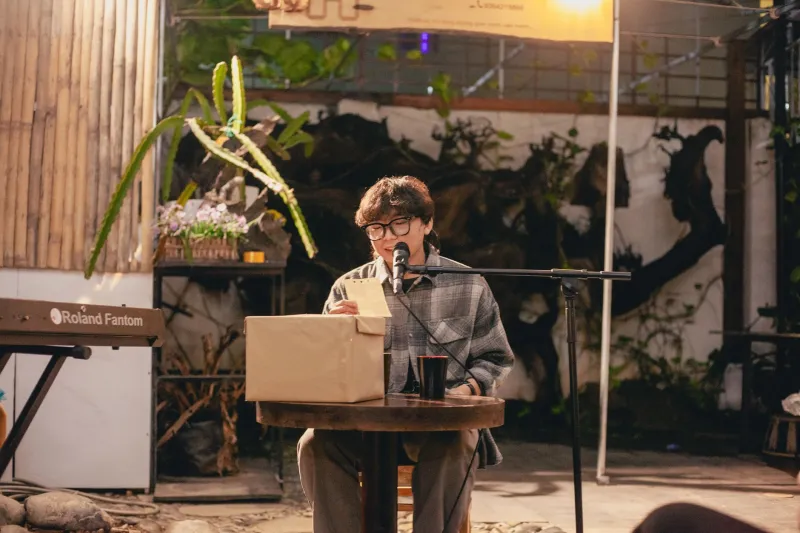
That's the first fact of most translated-poetry readings I give. The poet is in Kyoto, or asleep in a hotel in Chicago, or has been dead since 1998. Either way, there's an empty chair beside mine, a microphone in my hand, and a room that has just heard a poem in a language most of them don't speak. Then the Q&A starts.
I've been on both sides of that exchange—as translator and as audience—and I've noticed that the questions are almost always good. They're not gotchas. They're attempts to figure out what just happened. The trouble is that translators sometimes answer with either false modesty (I'm just a window) or false authority (the poem really says...). Both are lies, and audiences can smell them.
Here's the field guide I wish someone had handed me in a church basement in Ohio, back when I thought I could wing it.
1. Is it still their poem?
Yes—and also no. The poem belongs to the poet; the English belongs to me. I usually say, 'It's their poem in my reading of it, the way a cover song is still the songwriter's song and also the singer's performance.' That's not a dodge. It's the actual arrangement. What I try not to say is 'it's really my poem now,' which is rude, or 'I'm nothing,' which is a lie.
2. Why didn't you just use Google Translate?
I do use it. I run the poem through a machine, then I spend the next six weeks disagreeing with it. Google is a brilliant first reader and a terrible last one. It can give you the dictionary sense of a line; it can't hear that the poet chose a word because it rhymes with his ex-wife's name, or that a measure word is doing a small joke. Say that. Don't pretend you work in a cave.
3. Which one is the real poem?
There's a score and there's a performance. The original is the score. The translation is one performance, in one room, for one audience. If someone asks which to trust, I say: trust the original if you can read it; trust the translation as a report from a reader who was there. That's accurate, and it keeps me from claiming more than I can deliver.
4. Did the poet approve this?
If the poet is alive, sometimes yes, sometimes they say 'do what you need.' If the poet is dead, no—and I can't ask. Don't invent a blessing. Approval is not the same as accuracy: a living poet can approve a line that's wrong, and a dead poet can't approve anything. I say what happened in plain terms. Audiences respect the paperwork of it.
5. What's the poet like?
Don't turn them into a mascot. They're a person who writes poems, not a saint. If I have an anecdote that's mine to share, I share it; if I don't know them, I say so. The audience wants intimacy, but what they can actually use is specificity: how the poet drafts, what they argue about, why they chose that title. Gossip is cheap; craft detail is generous.
6. Can you read it in the original?
Yes—and then I say, 'You're not hearing the poem; you're hearing me pronounce it.' I read a few lines anyway. It lets them hear the texture, the consonants, the length of the breath. But I don't pretend my accent is the poem. If I'm shaky, I say I'm shaky. That's not a confession; it's information.
7. What's untranslatable?
Everything, and nothing. The mystical answer is boring. Most untranslatability is local: a pun, a measure word, a proverb everyone in 1980s Beijing knew. You can footnote it or you can build an equivalent. Say which you chose and why. Don't make it a mystery; make it a craft problem with a trade-off. 'I lost the pun and kept the rhythm' is a real answer.
8. Why did you change the line breaks, the title, the image?
Because the line was doing a job in the original that English couldn't do with the same number of words. Give one concrete example. Audiences love a concrete example more than a theory. Admit the loss. 'I traded the pun for the rhythm; I'm not sure it was the right trade' is better than a lecture on equivalence.
9. How do you know you got it right?
I don't. I know when it stops being wrong in the ways that matter. I know when I can read it aloud without flinching. I know when a reader who knows the original says 'yes, that's the poem'—and when one says 'that's not it,' I listen. Translation is a series of judgment calls, not a proof. The honest answer is the useful one.
The one sentence I keep in my pocket for the end of the night is this: 'I'm not here to speak for the poet; I'm here to make room for the poem.' It's a little grand, but it works. The poet isn't here. The poem is. The Q&A is where the room figures out how to be with it.