Whose Mouth Is This? Reading a Translated Poem Without Stealing the Room

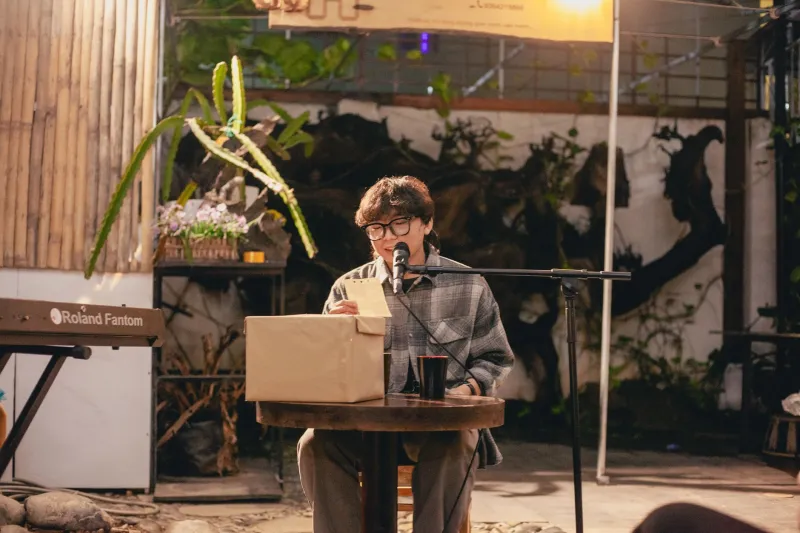
Photo: Yeend King, Public domain, via Wikimedia Commons
The first time I read a translated poem at an open mic in Oklahoma City, I spent the introduction explaining what the audience was about to miss. The original was in Chinese. The puns would not survive. The line lengths were doing something in the source that English could only approximate. By the time I reached the first line, I had turned a poem into a disclaimer. The room was patient. The poem was not served.
I have thought about that night a lot since, especially as open mics around the country have started including more translation — not as a novelty, but as part of the regular reading life of a city. In 2026, you are as likely to hear a translated poem at a bar in Tulsa or a bookstore in Brooklyn as you are at a university reading. That is good news. It also means more of us are standing at the mic with someone else's poem in our hands, wondering whose mouth this is supposed to be.
The First Ten Seconds Are a Credit, Not a Confession
A translated poem needs a clear introduction. It does not need a confession.
What I try to say is simple: the original poet's name, the translator's name if it is not me, the language, and the title. Something like: 'This is 'Night Bus'' by Li Shangyin, translated from Chinese by Jonathan Stalling.' If the poet is living, I say so. If the translation is mine, I say that too. If I am reading from a published book, I hold it up or name the press. Credit is not housekeeping. It is part of the performance.
What I try not to say is: 'I hope I don't butcher this.' Or: 'This is going to sound much better in Chinese.' Or: 'There is a pun here that you won't get.' Those lines may be true, but they ask the audience to forgive the poem before they have heard it. They also make the translator the subject. The poem should be the subject.
A short, confident frame does more than a long apology. The audience does not need to know everything you know. They need to know whose poem they are hearing and how to listen.
Your Voice Is a Second Translator
When I read a translation aloud, I am not trying to reproduce the original sound. I cannot. What I can do is make choices that serve the translation's own music.
That means paying attention to line breaks. If the translation ends a line on a hard consonant, I do not rush past it. If the syntax is deliberately knotted, I do not smooth it into a greeting card. If the poem is plain, I do not add drama to prove that it is deep. The translator made decisions on the page; the reader makes decisions in the air. Those decisions should agree with each other.
I mark my copies. I put a slash where I want a breath, a dot where I want a small pause, a double bar where the poem turns. I read the whole thing aloud at least three times before I bring it to a mic. The first time is for sense. The second is for pace. The third is for the places where my mouth wants to race ahead of the poem.
One more thing: I do not put on an accent. I do not try to sound 'foreign.' That is not interpretation. It is costume. The poem is already in English. Let it be in English.
When the Room Cannot Check the Source
At a US open mic, most of the audience will not know the source language. That is not a problem to be solved. It is a different contract.
When readers can check the source, they may compare. When they cannot, they listen for the poem's internal logic: its images, its turns, its emotional weather. Your job is not to prove that the translation is accurate. Your job is to make the poem audible as a poem.
If there is a crucial pun or cultural reference, decide whether it belongs in the introduction. Usually, one sentence is enough. 'The title puns on a word for both 'pine' and 'longing'' is fine. A three-minute lecture is not. And if you explain it before the poem, do not explain it again after. Trust the room.
The Body Has Opinions
The microphone is not a lectern. You do not have to hide behind the page.
I try to look up at the end of stanzas, not because I have memorized the poem, but because the audience needs to see that I am speaking to them and not just reading at them. I keep my hands quiet unless the poem asks for movement. I do not tap the mic. I do not sway in a way that turns every line into a lullaby.
If I am reading a bilingual poem, I sometimes read the source first and the translation second. But I do not make the source a party trick. The source is not there to prove that I am sophisticated. It is there because it is the poem's first life.
The Night I Got It Wrong
A few years ago, I read a translated poem too fast because I was nervous about the time. The poem had a turn near the end, a shift from description to address. I hit the turn at the same speed as everything else. The audience clapped politely. A friend told me afterward that she did not know the poem had changed direction until the last line.
That was my fault, not the translation's. I had treated the poem as a text to get through rather than a room to move around in. Now I practice the turn separately. I read the last four lines first, then the whole poem, so I know where I am going.
A Small Checklist Before You Step Up
Read the poem aloud once without stopping. Mark your breaths. Time it. Write your introduction on the same page as the poem. If you are reading someone else's translation, say the translator's name. If you are reading your own, say that too. Bring a copy for the host if the venue asks. Do not apologize for the source language. Do not apologize for the translation. If you make a mistake, correct it and keep going. The poem has already survived more than one language. It can survive one open mic.
Performing a translation is its own act of interpretation. It is not a footnote to the page. For four minutes, you are borrowing someone else's poem and giving it a body in a room. Do it like you mean it. Then hand it back with thanks.