The Lines That Follow Me Home: Ten Openings from Translated Poems
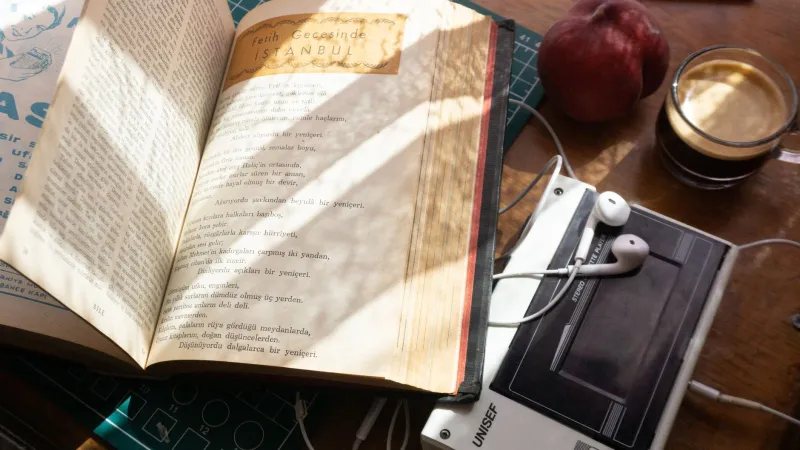
Every translator I know keeps a private mixtape: lines that arrive uninvited while you’re rinsing a coffee cup or waiting for the L. These are not necessarily the best poems I’ve read. They are the openings that make me want to start over—to reread, recite, or try a translation of my own. In 2026, my mixtape lives in a note on my phone. Here are ten tracks, in no particular order.
1. Homer, The Odyssey, translated by Emily Wilson
“Tell me about a complicated man.”
Wilson’s “complicated” did something to my ear the first time I heard it. It is plain, a little clinical, and then it opens up. The line asks for a story and admits the story will not be simple. I hear it twice: once for the nerve of the word, once for the invitation. It makes me want to read the next line out loud.
2. Dante, Inferno, translated by Henry Wadsworth Longfellow
“Midway upon the journey of our life”
The old-fashioned music is the point. “Our” is the hinge. This is not one man’s midlife crisis; it is a shared clock. Longfellow’s line sets a pace—slow, formal, a little solemn—and I like hearing the poem clear its throat before it goes underground.
3. Sappho, fragment 1, translated by Anne Carson
“Deathless Aphrodite of the spangled mind”
“Spangled” is a translator’s risk, and I love it. It makes the goddess glitter and think at the same time. The line is an address, so it already has a listener. Hearing it twice lets the consonants sparkle: deathless, spangled, mind. It is an opening that feels like an ornament with a pulse.
4. Bashō, translated by Robert Hass
“The old pond—”
The dash is the first event. Before the frog, before the water, there is a pause. Hass lets the line hang there, and the hang is the poem’s invitation. I like openings that do not push. This one makes room. Say it twice and the second silence is different from the first.
5. Rainer Maria Rilke, Duino Elegies, translated by Edward Snow
“Who, if I cried out, would hear me among the angels’ hierarchies?”
A question as an opening is a door left ajar. “Cried out” is ordinary human volume; “hierarchies” is cosmic bureaucracy. The clash is the sound of the whole elegy starting. I hear it twice because the first time I’m caught by the question, and the second time I’m caught by how lonely the grammar is.
6. C. P. Cavafy, Ithaka, translated by Edmund Keeley and Philip Sherrard
“As you set out for Ithaka / hope your road is a long one,”
This is advice, almost a blessing, and it arrives in the second person. That “you” is generous. It lets the reader into the journey without pretending the journey is easy. The line sets a long horizon. I like it for the same reason I like a good road song: it makes the destination less important than the going.
7. Pablo Neruda, Twenty Love Poems and a Song of Despair, translated by W. S. Merwin
“Tonight I can write the saddest lines.”
Simple, declarative, and already a little suspicious of itself. “Tonight” makes the sadness temporary; “can” makes it a skill. The line sounds like a song hook, but it is also a poet deciding to work. That double motion is why I keep hearing it.
8. Anna Akhmatova, translated by Stanley Kunitz and Max Hayward
“I taught myself to live simply and wisely”
The opening is a discipline, not a confession. “Taught myself” puts the speaker in charge and also admits the effort. I hear a whole life in the past tense of “taught.” It is the kind of line that makes me sit up straighter and then want to know what it cost.
9. Du Fu, Spring View, translated by Burton Watson
“The country is broken; mountains and rivers remain.”
The parallel is clean enough to feel like a door closing. Broken country, enduring landscape. The line sets scale in a single breath. I hear it twice because the first half lands like news and the second half lands like time. It is an opening that makes the poem feel bigger than the page.
10. Rumi, translated by Coleman Barks
“Come, come, whoever you are.”
Barks is a translator who works close to adaptation, and this line is famous for a reason. It is an invitation with no gate. The repetition is the music. Hearing it twice is almost the point: the second “come” is where the welcome becomes real. It is the last track on my mixtape because it sends me back out into the world.
Why Openings, Why Twice
An opening line is a translator’s handshake. It tells you what kind of room you’re entering: formal, plain, glittering, broken, welcoming. Hearing a line twice is not quality control. It’s a way of noticing the decision inside it. The first time, you follow. The second time, you hear the choice.
I don’t expect anyone to agree with all ten. A mixtape is supposed to be arguable. If you’re a poetry fan, make your own list and play it for a friend. If you’re a translator, steal one of these openings as a warm-up and see what your voice does with it. The point is not to crown a canon. The point is to keep the lines in circulation.